Hospice & Palliative Care

On Tuesday, January 18, our family enrolled Lynne in Hospice and Palliative Care with Continuum Care of Washington. The goal of palliative care is to help manage Lynne’s pain and reduce the side effects of medication required for her treatment. The goal of Hospice care is to treat Lynne as a whole and manage her symptoms rather than treating Alzheimer’s. Continuum will provide resources for medication management, skilled nursing care, medical supplies and equipment, and spiritual and emotional support. Continuum was recommended to us by the Aegis medical director based on their relationship with Continuum Care for current and former residents.

Lynne will remain in her apartment at Aegis receiving its current hospitality services with the added support from Continuum services already provided to current residents. A Hospice nurse will visit her once a week and a home-care-aide two times per week under the direction of a new primary care physician and liaisons who can assist us when we need more help.  The Hospice nurse and home-health aide know Lynne and are excited to care for her, so Lynne should welcome the continuity in her new plan.

Continuum responded effectively and thoroughly since late last week to complete approvals and assign staff on Tuesday. We are pleased with the extra care Lynne will receive in her current stage and her new team. Continuum prepared a 90-treatment plan based on their current examination and will follow up with a second 90-day care plan, followed by successive 60-day plans.

Continuum accepted her for care because of concern for her weight loss, frequent wide emotional swings, and two epileptic seizures last summer. Continuum hopes their additional services could reverse her weight loss and stabilize her moods to permit taking her off Palliative and Hospice Care. Aegis staff confirmed other residents have been taken off. If Lynne is removed from Continuum Care, it would only be temporary because she is in the last stage of Alzheimer’s.

Lynne’s brother, sister and her boys support the extra services she will receive. Lynne continues to welcome phone calls and cards, and visits when we return to post Covid restrictions.

Gems of Joy

Today’s post is from a longtime friend of Karen’s and mine who shared with me after my post about shifting my care during frequent mood changes (1/5/21 Shifting with Her Moods). Her sharing from her experience helped me, and I thought would be helpful for readers..

“ I read your Facebook post on shifting moods and it took me back to the 3-4 years we spent with my mother-in-law who had advancing dementia.  I’d like to share with you some of my ‘learnings’ during that time—some from reading, some from learning from my communication mistakes.  I hope they can help you realize that you are doing the best you can under constantly changing circumstances.

“I found that I had to give up my ‘teacher and reality orienting’ roles that I thought were so helpful.  I read an article that reminded me of what I knew worked so well with children: meet them where they are, go into their world and let them lead you.  I thought of that when Lynne said, “I hate this place.”  Letting her know that “I hear you,” or “This is hard, painful,” or something to that effect helps validate what her reality is for that moment–she’d rather not be there.

she went through multiple moods with tears, pushing me away, shouting at me, then smiling, focused, following me in and out of her apartment.  “My MIL’s mood swings were a challenge for me—until I realized that I was taking them personally, thinking there was something I could do to make them better.  My presence was my gift to her, whether her mood was positive or negative—I tried to be a sponge and just absorb and accept and witness them.  It helped me that I knew she would quickly change, and, better yet, would not remember or “accumulate” these unhappy moments as memories.

I had not helped her.” I cannot fathom how painful it must be as a parent to be unable to take away my child’s pain, the one thing (after unconditional love) that we see as our role.  But then I reviewed your description of your time with her.  You gave her nourishment when she couldn’t do it herself, you danced and laughed with her when she felt like it, you accepted her following you in and out of her apartment— all with love and acceptance of the moment.  It all helps—but those times cannot be exchanged like green stamps (if you remember them) to lessen those painful times for her.  I will pray for more joyful times than painful ones, more movement and engagement than withdrawal — perhaps that is all that can be hoped for.  Gems of joy to be gathered and returned to when times are tough.”

Shifting With Her Moods

Happy at 6:00 pm

At dinner Monday night Lynne was lackluster, listening to music on her headphones and verbalizing a few verses with her lips. She ignored her plate of gravy, beef, noodles and green beans, so I stabbed a bite of beef with a noodle which she let me put into her mouth. She let me feed her every bite. Staff gave both of us a slice of carrot cake for dessert with my own fork.

We walked to her apartment to watch TV, but after we watched repeated ads of Medicare Plan C, she said, “I can’t stand this,” and left the room. We laughed when we danced a little bit. We walked the halls as she went through multiple moods with tears, pushing me away, shouting at me, then smiling, focused, following me in and out of her apartment. She says, “I hate this place.” I tell her “Lynne you are safe here. Everyone loves you.”

Sad at 6:00pm

Finally, I turned her over to the nurse who said she had had a pretty good day, but she’d get her ready for bed. As I slipped out the door to the stairs, I heard her in the hallway sobbing and yelling, “What did I doooooo?”

That yell drove me to the edge of despair. What could I do? I had not helped her. I felt helpless. I expected and hoped she would switch moods again. And the nurse would help her, even sedate her. I closed the door and walked down the stairs. Her cry kept haunting me.

When I returned late that night, the caregivers said she had a pretty good night. They had the pack and headphones ready for me instead of having to look for them as we often do. With those readily available, them watching me feed her, offering me cake and my own fork, and now their assuring me they calmed her down, I felt like we were a team to give her care in this more depressing part of our journey. Her determination inspires us all  

Getting Help to Relive Memories

fun activities

With riends at a Lyle Lovet concert

People in late stages of dementia can relive memories wrapped in their five senses and heartwarming emotions. Those are the best times for Lynne and me now. I’d like to learn more ways caregivers can help loved ones relive those memories.
Recently, she was snug in the front seat of my car listening to Neal Diamond music and singing his lyrics as we drove through a rainy night. She looked out the window at parks and restaurants in her Madrona, Leschi and Capital Hill neighborhoods, interrupting her singing to briefly comment on the scenes. On a video chat she listened to me read every word of Sharon Olds’ poem, First Hour. It’s about a newborn’s thoughts. I told her that and when I finished she immediately remembered holding each of her three newborn boys.
I, we caregivers, want ideas to reach deep into more of those memories so we can relive them in restricted, confusing, anxious times.
I have read recommendations about how to assist Lynne’s behaviors when I’m with her. She opened a back door of the car to sit on the lowered seat, but said she couldn’t get her legs in. I guided her into the passenger seat. She quickly tangled her neck in the seatbelt until I clicked it in for her.
I’d like more training on drawing out the deep memories, especially when I can only care for her on a video chat or sitting alone with her, even then unable to touch her without gloves and a shield, let alone hug her. What senses and emotions help draw out pleasant memories? In the car, did feeling snug in her passenger seat relieve her anxiety and let her focus on the scenery? Was it the music? The lyrics? Me by her side? With the poem, did it help to feel secure in her favorite chair? Me introducing the poem by talking about newborns and mothers? Dad’s familiar voice? The flow of the lyrics?
I search for connections to memories by watching, listening, asking and showing her pictures to see what settings, words, images and names excite her senses and emotional experiences. I need help. And I confess I feel pressure because her reservoir of memories is draining away rapidly.
Can I get help from our worlds of virtual reality? Lynne had a fabulous time with friends at a Lyle Lovett concert two years ago. Could she wear virtual reality goggles and earphones to sing and dance with fans and friends at concerts like Madonna? Could she dance in sock hops on reruns of The Dick Clark Show? Could gaming programmers develop videos for people with dementia where they could hug avatars instead of zap them? Could exercise equipment manufacturers mimic virtual scenery while residents exercise on stationary bikes? Could we collect videos from family and friends to rerun in endless loops like TikTok videos? Could we download YouTube videos?
There must be people who could recommend more ways to raise up Lynne’s memories for us to enjoy in the present Covid restrictions — experts for caregivers, architects for room and building designs, owners of assisted living facilities with lively experiences from households or neighborhoods.
Please help.

Did We Ask Too Much?

Fun activities

Early before Lynne’s 2nd birthday party, she was crying, anxious, didn’t want to go. Why? Confined? Lonely? Isolated? Trapped? Embarassed? Caregiver Dorothy and I encouraged her. Dorothy escorted her. We had fun.

But did we ask too much? What about Christmas?

Special Caregiving at Thanksgiving

Fun activities during Thanksgiving

Lynne and her friend the Thanksgiving Turkey

Aegis reported they kicked off the week before Thanksgiving with a little fun in memory care. The Health Service Director dressed up as a Turkey and spent some time with Lynne and other residents. Lynne’s the one on the left in the photo. 😊 Holiday decorations should keep up the spirits during the upcoming “Week of Thanksgiving.” Staff will deliver different types of deserts for the residents and visitors every day on the Outdoor Living.
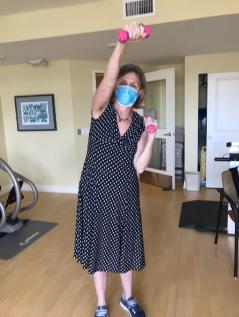
Lynne has been active with weights, a hair cut and shampoo and outdoor walks. One day, she came back from her walk and entered the daily stand-up staff meeting. They were pleased to see her and gave her a chair.
Lynne’s still caring for staff. She saw a caregiver have an incident with a difficult resident and said to her, “You’re having a bad day.”
A nurse told me about another bad day for Lynne. A resident hit her in the chest, hard enough to have her chest looked at, but there wasn’t a visible injury. When she was shaken by another incident she witnessed, caregivers led her onto her bike. After she pedaled herself into recovery, they asked Alexa to play Madonna so they could dance with her until she felt safe and settled. Caregivers continuously resolve such disturbing behaviors.
We have a lot to be thankful for, including caregivers in tune with Lynne during the loneliness on holidays. Bless them.

KOMONews on Lynne and Dad

This is the KOMONews report on Lynne’s and my story regarding the Alzheimer’s walk. https://komonews.com/news/consumer/dont-underestimate-covids-effect-on-people-with-dementia. I’ll be at Aegis-Madison if any of you want to join me Saturday, October 3 beginning at 8:45 am. You can see me and Connie Thompson of KOMONews at the virtual walk sites because she also has an Alzheimer’s story. Links are on the Alzheimer’s website for Seattle.

Deciding to be a Hopeful Caregiver

video chats fun activities

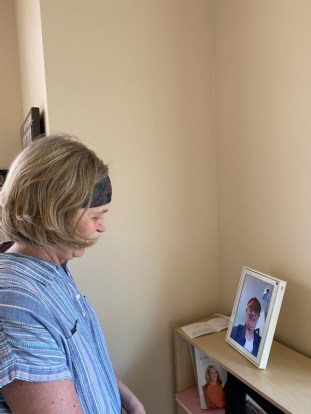
Lynne called me to video chat because she was bored. Her caregiver was standing by.

”I’ll be back in a little while to see what you want to watch on TV.”

That was encouraging to know. I suggested we dance to music from her Alexa dot. She liked that idea. Then a resident slowly walked behind Lynne to sort through Lynne’s bedding. Lynne turned around to see her. She said hello and called her by name, “What are you doing here?”

She silently continued browsing. I suggested Lynne help her leave the room. Instead of walking over to guide her out, Lynne walked out of the Portal camera view toward her door. Meanwhile her friend continued sorting through the bedding until she found two books. She lifted them up to eye level with one hand and shuffled away toward the door. I heard no sound. I waited and hung up.

I felt helpless. I couldn’t help her help another resident. I couldn’t help her protect her books. I couldn’t talk with her. I couldn’t help her dance.

I decided to believe in hope. Lynne was no longer bored. And she was helping a resident; and she found her caregiver to help her; and they convinced the bargain hunter to return Lynne’s books; and Lynne could browse through other residents rooms to replace her books; and by this time she was watching her favorite TV show; and we’ll dance another time.

I also decided we need to keep sending her paperbacks because we’re stocking Lynne’s whole floor.

At least I cared for me as her caregiver under Lynne’s COVID-19 quarantine.  

A Normal Video Chat in an Oasis

Fun Activities

A caregiver and Lynne called Sunday night for no reason other than to video chat. No tears, no fears. Almost normal. 

I told her I had a scan scheduled for Tuesday and had to avoid chocolates for 24 hours beforehand, so I was going to have chocolate cake for breakfast. She laughed.

I asked if she was eating lunch in her bedroom or with other residents. She didn’t know. “I haven’t paid attention to that. They have places on the floor and the tables, so we’ll be safe.” 

She had the new book in her hands from her sister Pam. She took the flyleaf off and scanned it and scanned the book, hesitating as she read each word in the title. “I’m excited about it.

Ok, remember when you get a new book you have to return one for me. Return Bear Town because I hadn’t read it yet.”

The caregiver was still there so he looked for it in her shelves. She said, “No, it’s not there,”

She tugged back her blanket and sheet to rummaged through them until she found a couple of books and found it. She gave it to the caregiver to leave with the concierge.

We chatted for 18 minutes. I updated her on Pam suffering in wildfire smoke, her niece liking her visit to Lynne’s alma mater Oregon, and on an on. She responded with understanding to each one.  When I paused wondering what to say, she said, “Well, I should go.”

We told each other we loved each other.

Those oases of normalcy are normal with Alzheimer’s. They are abnormally wonderful to experience and share. And I believe her cognitive clarity was also helped by the major reduction in COVID inactive isolation.  She’s escorted outside daily, exercising regularly, walking her floor, helping fellow residents, getting video chats.

Whatever, we persist and give thanks for each oasis.      

Lynne Takes One for the Team

Fun Activities

Lynne Freed to Exercise with Weights

Lynne summoned the courage to suffer one for the team to contain the COVID virus.

Thursday she dressed up to return to exercising in the Aegis gym with weights. She’s walked city streets every day, as much as twice a day from what I hear. Her high-tech friends have called me with reports from their chats, such as Lynne misses her sister. Her boys dropped in for video chats on their Facebook portals since they now have their own Portals. Connections are not without glitches because staff leave before making sure Lynne is set up in a chair in front of the Portal with a lamp on so we can see her face. We’ll improve on that.

Saturday Lynne and a caregiver connected with me. She said, “I’m not sure I can take this.”

“Of course, it’s hard. But remember you don’t have to stay in your room now. You can walk your floor. You can go outside to the patio.”

“Can I go down to the concierge?  Some of these people …” 

“No, because your floor still has a COVID lockdown from the rest of the facility.  Aegis is protecting the other residents from infections from your residents and protecting the very frail people on your floor. You’ve got to protect other people.  You’ve got to take one for the team right now.”

She took a deep breath. “OK, I can do that.”

“Let’s call your sister. She’s having a tough time with hazardous smoke from wildfires that kicked up an asthma attack.”

We added Pam to the call. I said I had to go and let my daughters chat.